The cheapest route from a Super Nintendo to a modern television is a $15 composite-to-HDMI converter box, and the most expensive mainstream route is a RetroTink 4K at $750. Both produce an HDMI signal your TV will accept. Only one of them will make the same game look the way its artists intended, and the gap between those outcomes is where most first-time retro buyers lose money.
This guide explains why the problem exists at all, what each class of adapter actually does, and which solution fits which console, budget and television as of 2026.
Why can't a retro console just plug into an HDMI port?
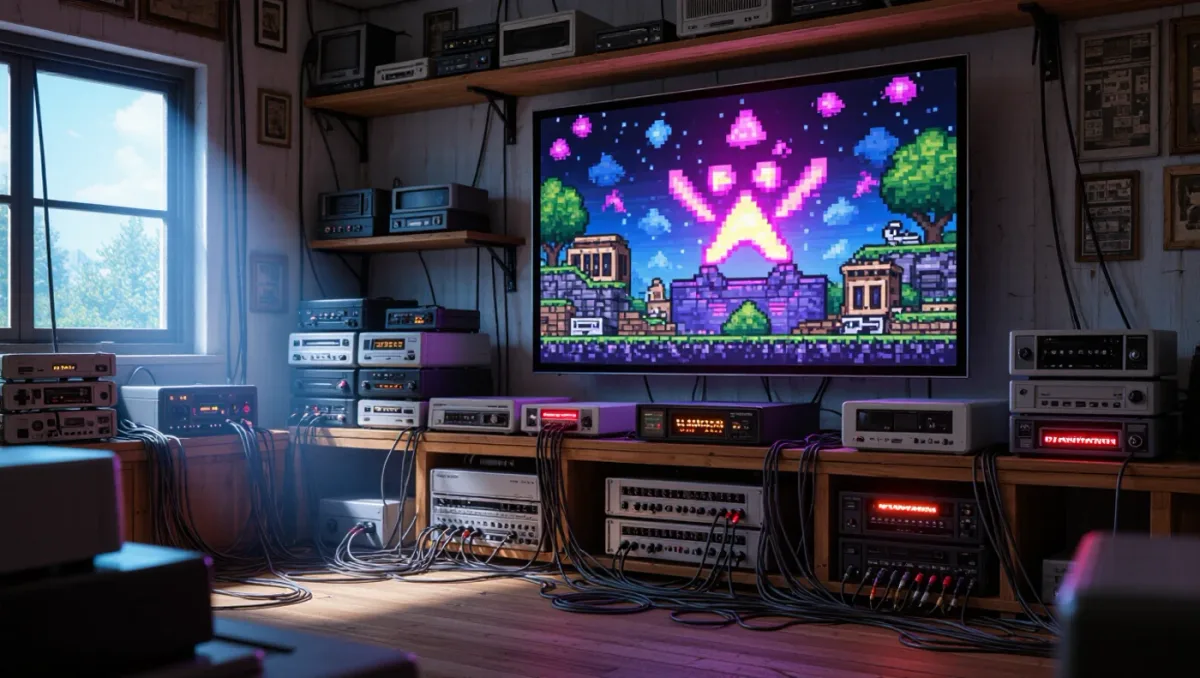
Consoles from the Atari 2600 through the GameCube's early days output analog video: composite, S-Video, RGB or component, at 240p or 480i scan rates that modern fixed-pixel displays were never designed to accept. Most current TVs no longer carry analog inputs at all, and the ones that do typically process a 240p signal badly — they assume 480i, deinterlace a picture that was never interlaced, and smear the result. Add 30 to 100 milliseconds of TV processing lag and light, timing-critical games feel wrong even when the image looks acceptable.
An adapter's job is therefore threefold: digitize the analog signal cleanly, interpret the console's non-standard timing correctly, and present the result to the TV at a resolution and refresh it handles well. Every price tier is a different answer to those three tasks.
What do cheap converters actually do?
The generic composite or S-Video to HDMI dongles sold everywhere for $15 to $40 are worst-case examples of all three jobs. They sample color roughly, guess at sync, and upscale with bargain-bin processing. The image is typically soft, color-shifted and laggy. They are usable for casual turn-based games and are the correct answer for almost nobody else.
A meaningful step up is a console-specific HDMI mod: an internal board installed in original hardware that digitizes video at the source. Mods for the Nintendo 64, Sega Saturn and Dreamcast are the common examples, with installed costs typically in the $150 to $250 range including the mod board and a technician's labor. The output is clean, low-lag and one-cable simple, at the permanent cost of opening the console.
Where do line doublers like the RetroTink fit?
The middle and top of the market belong to dedicated external scalers, and the current reference points are RetroTink's line and the Open Source Scan Converter.
- RetroTink 2X Pro and 2X Multimedia (roughly $120 to $180): each incoming line is drawn twice, turning 240p into 480p that every TV loves. Zero visible lag, dead-simple operation, and the best value in the hobby for 8- and 16-bit systems.
- RetroTink 5X Pro (about $325): flexible output up to 1440p, scanning-mode auto-detection, and the practical pick for one box serving everything from an Atari 2600 to a PlayStation 2.
- RetroTink 4K ($750): 4K output, per-console profiles, low-latency 120 Hz modes and the most precise scaling in the consumer space. It is an enthusiast instrument, not a requirement.
- OSSC (roughly $230 to $280 when in stock): an open-source line multiplier with exact 'pixel-perfect' integer modes, strongest for RGB-capable consoles via SCART. Stock availability has historically been sporadic.
All of these assume good analog input. RGB SCART or component cabling into a quality scaler is the reference chain; feeding a RetroTink 4K from a worn composite lead is polishing a mud pie.
Do you even need the scaler for newer retro consoles?
Consoles with built-in digital or high-quality output change the math. The Dreamcast's VGA output, the GameCube's Digital AV port with a component cable, the PlayStation 2's component output and the original Xbox's HD pack all deliver progressive 480p that modern TVs process far more gracefully than 240p. For those machines, a good component-to-HDMI transcoder in the $80 to $150 range is often the sweet spot, reserving the fancy scaler for the 240p-heavy library.
Meanwhile the console makers themselves have entered the business: Nintendo, Sony and Sega all ship emulation-based re-releases and subscription libraries, which sidestep the analog problem entirely at the cost of accuracy and library depth. For a growing list of players, 'the adapter is a subscription' has become the honest alternative — and that tradeoff is personal, not technical.
What should you actually buy, by budget?
- Under $50, one console, casual use: a console-specific quality cable plus a generic converter is the floor. Accept the compromise or save up.
- $120 to $200, one 8/16-bit console, weekly play: RetroTink 2X class line doubler plus proper S-Video or RGB cabling. This is the hobby's best value bracket.
- $250 to $400, several consoles across eras: RetroTink 5X or OSSC, a SCART or component switch, one clean cable run to the TV.
- $750 and up, enthusiast setups and large 4K screens: RetroTink 4K with per-console profiles, ideally fed RGB from every console that offers it.
One more practical note: HDMI modded consoles and external scalers are complementary, not competing. A common endgame is one internally modded N64 plus a 5X-class scaler serving the rest of the shelf, which keeps the TV's single HDMI input from becoming a swapping chore and keeps lag near zero across the whole library.
Verdict: skip the $15 dongle for anything you play seriously; a 2X-class line doubler with good cables covers 90 percent of players for under $200, and the 4K tier is justified only by large 4K displays and completionist intentions. Buy cables before boxes — the adapter amplifies your signal's quality, and cannot create it.