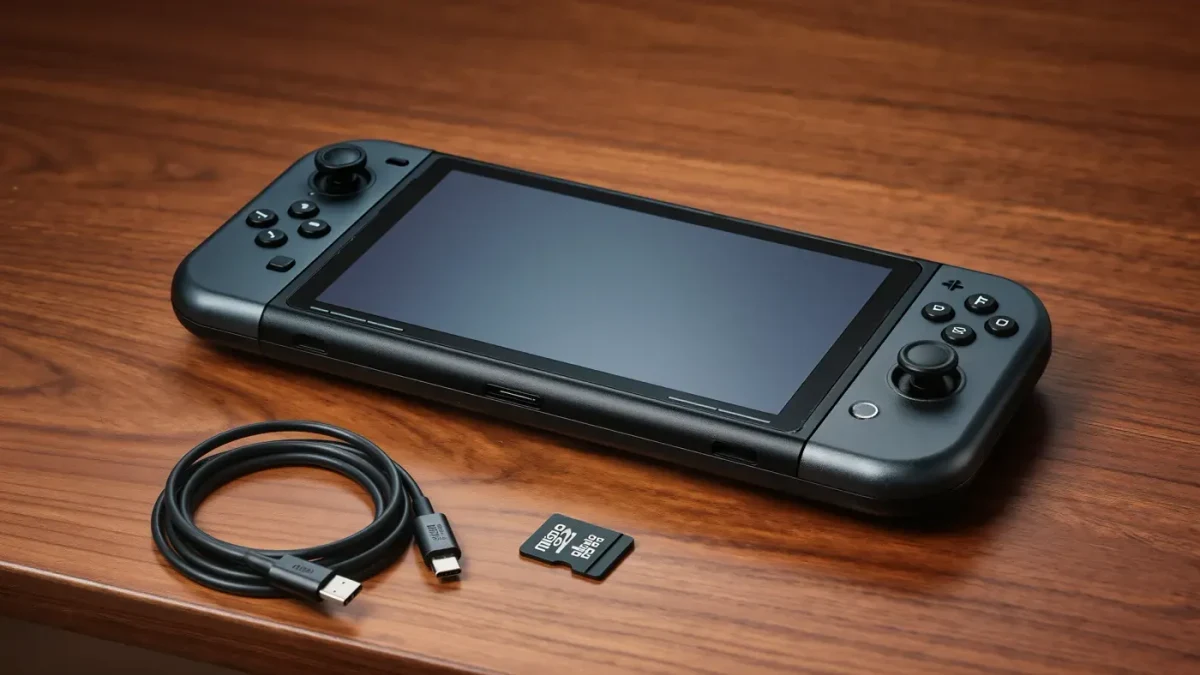
The handheld gaming market in 2026 is a three-way argument about philosophy, not hardware. Nintendo's Switch 2, launched June 5, 2025 at $449.99, sells a closed ecosystem tuned for its own games. Valve's Steam Deck OLED, on sale since November 2023 from $549, sells your existing Steam library with Linux underneath. ASUS's ROG Ally X, $799 at launch per ASUS's product page, sells raw Windows-compatible PC power. Every one of them plays great games; none of them plays all games. The buying question is which of your libraries matters most, and each machine answers it differently.
What does the Switch 2 offer that the PC handhelds cannot?
Exclusives and consistency. The Switch 2 runs Nintendo's first-party catalog — Mario Kart World, Donkey Kong Bananza and the rest of the 2025-2026 slate — that exists nowhere else, and its games are engineered to a single spec: per Nintendo's sheet, a 7.9-inch 1080p 120 Hz handheld screen, 4K 60 output when docked, and a custom NVIDIA chip with DLSS upscaling. A Switch 2 game is guaranteed to run well because it was built for exactly one configuration. The tradeoffs are equally structural: games cost $69.99 or more, the 256 GB storage fills fast, online play needs a Nintendo Switch Online subscription, and there is no way to buy games outside Nintendo's store.
Where does the Steam Deck OLED win?
On library economics and openness. The Deck runs SteamOS, and your existing Steam library — including the Steam sales that routinely cut games 75 percent — is the same library your PC uses, with saves syncing through Steam Cloud. Per Valve's specifications, the OLED model carries a 7.4-inch 800p OLED screen at 90 Hz (120 Hz support in some titles), 16 GB of RAM, and 512 GB to 1 TB of storage. Proton, Valve's compatibility layer, runs the large majority of Windows games, though titles with aggressive anti-cheat — most major competitive shooters — remain blocked, and Valve's own compatibility ratings on each store page tell you before you buy. Battery life on the OLED, at three to twelve hours depending on load per Valve's claims and independent testing, beats both rivals' endurance in lighter games.
What is the ROG Ally X's case?
Performance ceiling and total compatibility. The Ally X is a full Windows 11 machine with AMD's Z1 Extreme APU, 24 GB of fast LPDDR5X memory and an 80 Wh battery — the largest in this class, per ASUS's spec sheet — plus a 1080p 120 Hz IPS panel with VRR. Because it is Windows, every PC launcher works: Steam, Epic Games Store, Game Pass, GOG, Battle.net. Xbox Game Pass is the hidden killer feature — a $29.99 Ultimate subscription turns the Ally into a portable Xbox catalog. The costs are Windows itself: a busier interface designed for mouse and keyboard, more background drain, and ASUS's Armory Crate launcher layering over Windows to make it console-like, which improved after launch updates but never fully disappears.
How do they compare on the numbers that matter?
Frame-rate-per-dollar tells part of the story: the $449.99 Switch 2 plays its optimized catalog flawlessly and nothing else; the $549 Steam Deck plays most of PC gaming at 800p comfortably; the $799 Ally X plays everything at higher settings and frame rates, and independent testing consistently places it 20 to 40 percent ahead of the Deck in demanding titles. Battery reality check: demanding 3D games drain all three in roughly 1.5 to 3 hours — the Deck's advantage shows in indies and older titles, where its OLED sips power. Weight: Switch 2 at 534 grams per Nintendo, Steam Deck OLED at 640 grams per Valve, Ally X at 678 grams per ASUS — noticeable on long sessions in that order.
What about the newer Xbox-branded Ally?
ASUS and Microsoft announced a jointly branded line in June 2025: the ROG Xbox Ally and ROG Xbox Ally X, which per the companies' announcement ship a Windows-derived Xbox full-screen experience designed to boot into a console-style interface and launch Xbox Cloud Gaming, Game Pass and installed PC titles from one storefront-style home. The Xbox Ally X carries the same Z1 Extreme-class silicon as the original Ally X with a larger battery, while the standard Ally slots in below it at a lower price. For this comparison the implications are simple: the Ally X's Windows friction is now being actively patched by two companies rather than one, and buyers in late 2025 or later can choose the Xbox-branded variant if the console-like front end matters more than raw desktop access. The library argument — everything a Windows PC runs — does not change.
Which handheld for which player?
Buy the Switch 2 if Nintendo games are the point — it is the only handheld where they exist, and docked 4K output makes it a living-room console too. Buy the Steam Deck OLED if you already own a Steam library, value 800p OLED image quality, and play single-player PC games; it is also the calmest interface of the three. Buy the ROG Ally X if Game Pass or multi-launcher PC gaming is your center of gravity and you want the strongest silicon this side of a gaming laptop. The mismatch to avoid: buying a PC handheld expecting Nintendo exclusives, or a Switch 2 expecting a cheap PC library — neither machine pretends to be the other.