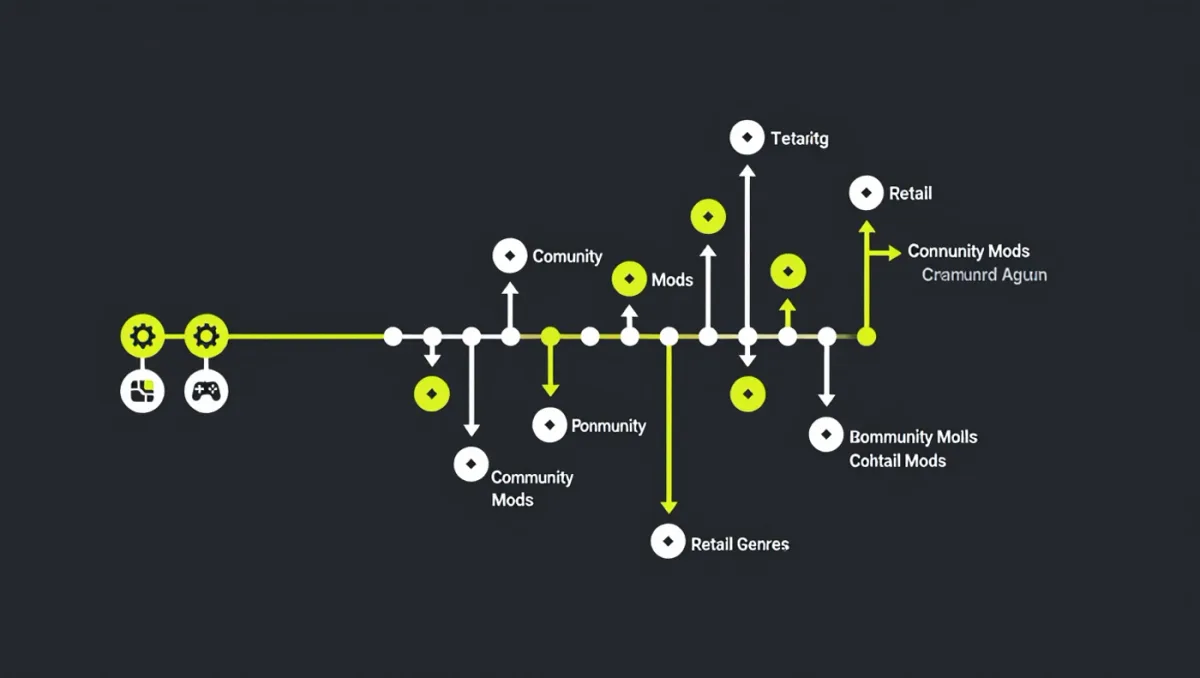
In 1999, Minh Le and Jess Cliffe released Counter-Strike, a free modification for Half-Life built on Valve's publicly documented tools. A year later Valve bought it. In 2003, the Warcraft III custom map Defense of the Ancients — iterated by community maintainers including the developer known as IceFrog — spawned the MOBA genre, and Blizzard eventually hired its lineage to build Dota 2. In 2012, Brendan Greene's battle royale mod for Arma 2 established the template that PUBG turned into a record-shattering retail product, per Playerunknown's Productions' own history, and by 2020 battle royale was the biggest genre in gaming.
Three of the past quarter-century's dominant genres began as unpaid fan projects hosted inside other people's games. Modding is not a hobby adjacent to the industry; periodically, it is the industry's actual research lab.
How did modding become structurally possible?
Every mod scene depends on a publisher's decision to leave doors open, and the great eras map to specific door-openings. id Software shipped Quake (1996) with modifiable data files and, crucially, a game logic engine written in an interpretable language, producing Team Fortress, Capture the Flag conventions and an entire deathmatch culture. Valve shipped the Half-Life SDK (1998-1999) with level editors and documentation, and Counter-Strike, Day of Defeat and Natural Selection walked through. Epic's Unreal Editor created both the modding culture and, via mods like capture-the-flag-era comps, hiring pipelines; Bethesda's Elder Scrolls Construction Set created the longest-running single-game mod ecosystem in gaming — Skyrim's workshop community has shipped more content hours than the base game by orders of magnitude.
The pattern holds across all of them: a kit of documented tools, a file format the community can edit, and a publisher that tolerates free distribution. Where any leg is missing, scenes stay small — console ecosystems before recent years, and any engine whose tooling treats the player as a customer only.
What does the pipeline from mod to product look like?
The acquisition-and-hiring route is well worn. Valve purchased Counter-Strike's team and shipped it as a retail product in 2000; the same fate met Team Fortress and Portal, which began as the student project Narbacular Drop before Valve hired its developers. Riot's League of Legends and Blizzard's Dota 2 commercialized the DOTA lineage, with IceFrog joining Valve. Greene went from Arma modder to PUBG Studios' creative direction. Modding functions as a portfolio system the industry reads fluently: a mod with players is proof of shipping ability, community management and design judgment in one artifact.
The second route is genre escape rather than hiring — the Auto Chess case being the cleanest recent example: Drodo's 2019 Dota 2 custom map invented auto-battler as a category within weeks, and the studio's own standalone version plus a wave of imitators turned a map-editor experiment into a genre with its own tournaments inside a single year.
Why does paid modding keep failing?
The scene's recurring conflict is monetization. Valve's 2015 paid mods experiment for Skyrim's Workshop collapsed within days under community backlash over revenue splits and ownership of derivative work, per Valve's own shutdown statement. The question underneath never resolved cleanly: a mod is by definition derivative, built on the host game's assets and tools, and whoever pays for one has bought an asset whose legal foundation belongs to the publisher. The pragmatic settlements — donation links, Patreon-funded development, Valve's 2017 paid workshop for select titles with stricter terms — work at small scale, but the 2015 failure remains the defining lesson: communities organize around free circulation, and monetization breaks the trust that produces unpaid labor.
Preservation gives the whole scene a second life worth noting. When official servers and storefronts retire older titles, mods are frequently what keeps them inhabited — multiplayer communities organized around fan-run servers have outlived their publishers' interest by decades, and total-conversion mods have, more than once, become the definitive way a classic is experienced. That makes mod archives infrastructure rather than trivia: the sites that host decades of files, with version histories and compatibility notes, are doing quiet preservation work that no corporate body has ever matched, and their take-down exposure is one of the gray zones the industry has never formally resolved. Support those archives; they are the reason old games still have players and new modders still have teachers.
What should a player or would-be modder know?
- Start where the tooling is friendliest. Bethesda games, Minecraft, RimWorld and Cities: Skylines have decades of tutorials and forum archives; starting on a scene with doc-heavy traditions shortens the learning curve by years.
- Read the host game's mod policy first. Publishers differ on what is distributable, monetizable and portable — and a mod built on a hostile policy can be shut down regardless of quality.
- For players: check the mod's maintenance status. A mod is a dependency of your game install; abandoned mods break on host patches, so treat version compatibility notes as the first thing to read.
Verdict: every genre now standard was once someone's free download, which makes mod scenes the cheapest talent pipeline and R&D department in software. For publishers, the lesson is instrumental: ship tools, tolerate derivative work, watch the workshop — the next Counter-Strike announces itself years in advance. For players and aspiring developers, the lesson is historical: the shortest path into the industry has, three times running, run through somebody else's game editor. Should you mod instead of making a small game? If you want players fast — yes; the distribution problem is already solved.