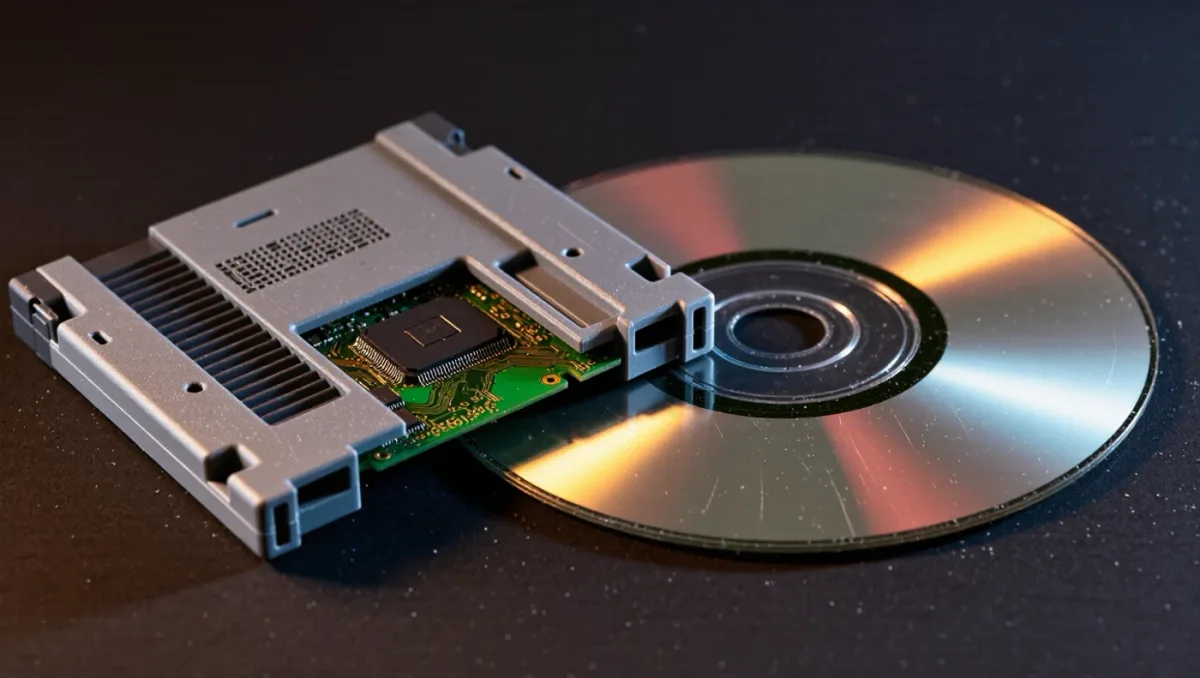
A loose NES cartridge from 1986 will very likely still boot on real hardware today, while a pressed CD-R burned in 2001 has decent odds of being unreadable right now. That asymmetry is not luck. Game media age on wildly different clocks, and understanding the failure modes of each format is the difference between a collection that outlives you and a shelf of beautiful plastic coasters.
The headline number: masked ROM chips, the storage inside cartridges, are commonly rated for data retention of 100 years or more at room temperature, while pressed optical discs rely on a reflective layer and lacquer seal that can fail within 20 to 50 years depending on manufacturing quality. Here is how each major medium actually works, how it dies, and what a collector should do about it.
How does a cartridge actually store a game?
A cartridge is not one thing; it is a small circuit board carrying one or more mask ROM chips, the game's data fixed at the factory by hard-wiring it into the silicon. Because the data is physical structure rather than stored charge, there is nothing to leak away in normal storage. What does fail is the periphery:
- Connector corrosion. Edge contacts oxidize. Ninety percent of 'dead' cartridges are fixed with isopropyl alcohol and a cotton swab on the board, not the plastic shell.
- Battery-backed saves. Games from the NES through the Game Boy Advance era used a CR2032-style lithium cell to hold SRAM save data. Those batteries, with nominal 10-to-20-year lifespans, have been dying en masse since the mid-2000s. The save dies; the game code does not.
- Failed solder joints. Thermal cycling and rough handling crack joints on the chips. A magnifier and a soldering iron fix what a replacement console cannot.
The catch in the modern era is that later cartridge generations moved away from mask ROM. Game Boy Advance and Nintendo DS cards frequently use NAND flash, which stores bits as trapped charge in floating-gate cells and does leak. Charge bleeds faster at heat, and flash data retention is typically rated 10 to 20 years, not 100. The newest carts are, in preservation terms, the most fragile.
Why do discs rot, and which ones rot fastest?
A pressed disc is stamped polycarbonate with pits molded into one surface, a microscopically thin reflective layer, and a lacquer coat on top. The data layer sits millimeters from the air on DVDs and Blu-rays, but on CDs the label side is the vulnerable face: the lacquer protecting the reflective layer is roughly 30 microns thin. Moisture ingress oxidizes the aluminum reflective layer — the familiar bronzing 'laser rot' — and the disc becomes unfixable. Nothing a collector does reverses it.
Manufacturing quality dominates outcomes. Well-pressed CDs from major plants routinely pass 30 years; the notorious failures came from specific plants and eras, including certain European pressings in the late 1980s and a range of DVD pressings from the early 2000s. Disc rot is stochastic: two copies of the same game from the same pressing can diverge completely within a decade.
Recordable media is a separate disaster. Dye-based CD-Rs and DVD-Rs degrade measurably faster than pressed discs, and early high-speed burns were worse still. Any retro archive built on burned media is on a countdown clock measured in years, not decades.
What about magnetic media and digital downloads?
Floppy disks — the default for 8-bit home computers — store bits as magnetic domains on oxide film, rated on the order of 10 to 20 years, and vulnerable to mold in humid climates. Original disks for Amiga, Commodore 64 and DOS games are the least reliable mass of retro media in circulation, which is why imaging projects that read and archive flux-level copies have been running for years.
Digital storefronts are their own preservation problem. When a storefront closes, entitlements can vanish with it; the Wii Shop Channel's 2019 shutdown and the 2023 closures of the Nintendo 3DS and Wii U eShops removed legal purchase paths for thousands of titles that have never returned elsewhere. A download is only as durable as the company's interest in serving it.
Which format should a collector actually trust?
Ranked by expected survival at room temperature in normal storage:
- Mask ROM cartridges (NES through N64, SNES, Mega Drive, most GB/GBC): effectively permanent, with battery and connector maintenance.
- Pressed optical discs (well-manufactured): decades, with rot as an unpredictable tax; store vertically, cool, dark, and verify checksums if you archive.
- Flash-based carts (GBA, DS): plan on refreshing saves and dumping data within a decade or two.
- Recordable and magnetic media: treat as already dying; migrate immediately.
The practical playbook is the same for everything: dump your media, verify the dump, store the original properly. Cartridge dumping tools and optical drives with accurate reading modes have been available to hobbyists for years, and a personal backup of a game you own is the foundation every preservation effort, legal or otherwise, starts from.
Does this explain cartridge price premiums?
Partly. The market prices scarcity and nostalgia more than longevity, but longevity underwrites confidence: a collector knows a Super Mario Bros. cart will still run, so demand holds. Disc-heavy eras carry a hidden risk premium the market has not fully priced — a sealed copy of an early-2000s PS2 title is a bet on one factory's lacquer. When you weigh what to buy, the question is not only 'is it rare?' but 'how many years does this medium have left, and does the price care?'
Verdict: for long-horizon collecting, cartridge-era games are the sturdiest artifacts in the hobby, and disc-era collecting should include a dumping habit from day one. Buy what you will actually play, keep it cool and dry, and assume no retailer will re-serve you a file you did not back up.