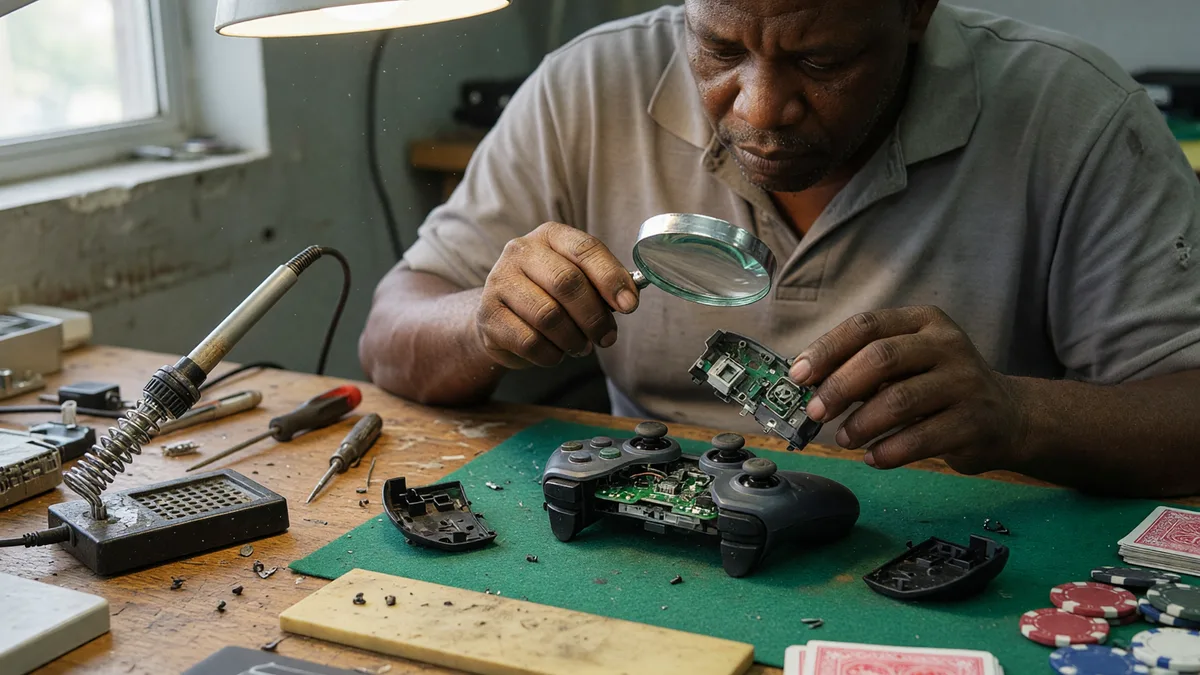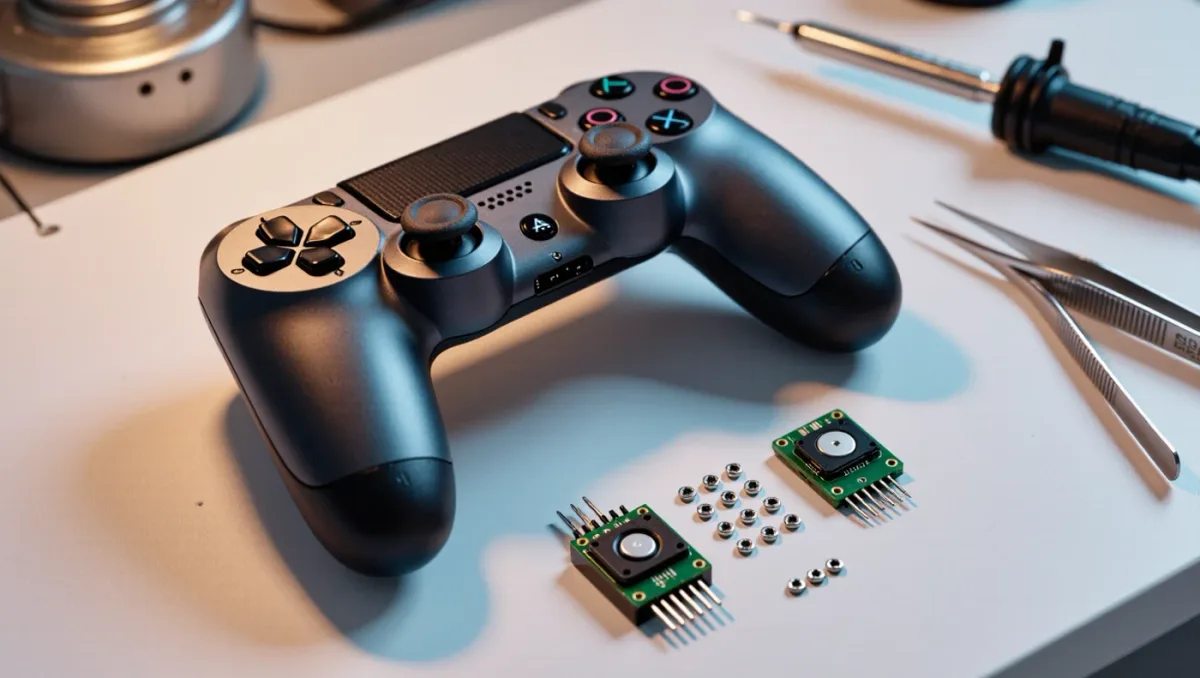
Stick drift was the controller industry's most reliable flaw for two decades: per class-action filings against Sony, Microsoft and Nintendo between 2019 and 2021, a meaningful share of first-party controllers developed drift within a couple of years, as the potentiometer wipers inside their sticks wore through their conductive tracks. The response arrived from outside the first parties. Beginning with hobbyist replacement modules and mainstreaming through 8BitDo, Gulikit, GameSir and finally the first parties themselves — Sony's DualSense Edge offers user-replaceable stick modules per its product page, and hall-effect options now appear across price tiers — magnetic sensing has become the standard answer. Understanding what changed requires knowing what was breaking.
Why do potentiometer sticks drift?
A conventional thumbstick is a position sensor: a physical wiper slides along a carbon resistive track, reading voltage proportional to angle. That contact is both the sensing method and the wear mechanism. Friction grinds carbon dust into the track, contact pressure changes with wear, and the reading — your stick's center — shifts. Per controller repair specialists' teardown documentation, this is mechanical aging, not software or firmware fault, and no recalibration fixes it permanently because the physical reference point itself has moved. Spring fatigue and stick-cap friction add their own contributions, but the wiper-track interface is the mechanism that calibration cannot repair.
How does Hall effect sensing differ?
It removes the contact. A hall-effect stick measures the angle of a magnet attached to the stick shaft using stationary magnetic field sensors — no component slides on another. Per the sensor technology's published characteristics, the result is a sensing mechanism with no inherent wear path: no dust, no track erosion, no drifting center from friction. TMR (tunneling magnetoresistance) modules, which Gulikit and others began shipping in 2024, refine the same idea with higher sensitivity and lower power draw per the manufacturers' claims. The practical consequence measured by the repair community: hall-effect modules eliminate contact-based drift entirely, leaving only rare electronic calibration faults as failure modes.
Which controllers offer it now?
The market has stratified, per manufacturer specifications. Budget and mid-tier third-party pads — 8BitDo's Ultimate line, GameSir's Cyclone and Tarantula lines, Gulikit's own controllers — ship hall-effect or TMR sticks from roughly $30, making the technology the default expectation in that segment. Enthusiast controllers such as 8BitDo's Ultimate 2 and pro-oriented GameSir models add TMR sticks, adjustable triggers and profile switches near $50-70. First-party adoption trails: Sony's DualSense Edge at $199.99 solves the problem differently with swappable modules, and Microsoft's Elite Series 2 similarly relies on replaceable components, while Nintendo's Switch 2 Pro Controller, per its documentation, retains conventional sticks but with revised internals — and Joy-Con 2 magnetic attachment per Nintendo's announcement changed the mechanical stress pattern on the handheld side. Third-party hall-effect pads for every current console carry the technology the first parties have not.
What are the tradeoffs nobody advertises?
Three, all manageable but real. Calibration: magnetic sensors output analog signals that need per-unit calibration curves, and budget implementations can show slight nonlinearity at the stick's edges — the reason testing tools like Gamepad Tester remain worth running on a new pad. Quality variance: 'hall effect' describes the sensor, not the assembly; a hall-effect stick in a cheap shell still gets loose-fitting shafts and weak springs, which produce wobble and sloppy centering that feel drift-adjacent. And polling and firmware: the sensor is only as good as the controller's processing — a 1,000 Hz sensor read by an 8-bit-era microcontroller delivers marketing, not precision.
Should you retrofit your old controller?
For the repair-inclined, yes: replacement hall-effect modules exist for Joy-Con, DualSense and other common controllers at $15-30 per pair, per module vendors' listings, and the install for Joy-Con-class sticks is documented across the repair community at moderate difficulty — soldering on some models, none on others. The economics work best exactly where drift hits hardest: a $70 controller revived for $25 beats a $70 replacement. For first-party pads under warranty, though, manufacturer repair preserves the warranty that replacement voids.
How do you test whether your sticks are healthy?
Objectively, in five minutes. Free browser tools such as Gamepad Tester draw the raw stick output of any connected controller: leave the stick untouched and watch for movement in the dot (drift at rest), then trace slow circles at constant radius and watch for flat spots or jumps (nonlinearity or sensor faults). Console owners without browser access can use in-game input viewers — fighting games and shooters increasingly include them, and Nintendo's system settings include stick calibration screens that reveal the same faults. Numbers worth knowing: a healthy stick reads near-zero on both axes at rest with a smooth circular trace; a drift case typically shows a resting offset of 2-10 percent; a dying potentiometer shows jitter — the value flickering while your hand is still. Run the test on any new purchase during the return window; drift faults that emerge later emerge from these signatures first.
Verdict
Buy hall-effect or TMR sticks by default in the third-party market — the premium has collapsed to nearly zero, and the failure mode it eliminates was the most common in the category. Treat the label as a floor, not a guarantee: sensor quality, shell quality and firmware decide the rest. First parties' premium modules remain a premium solution to a problem a $40 third-party pad now simply does not have.