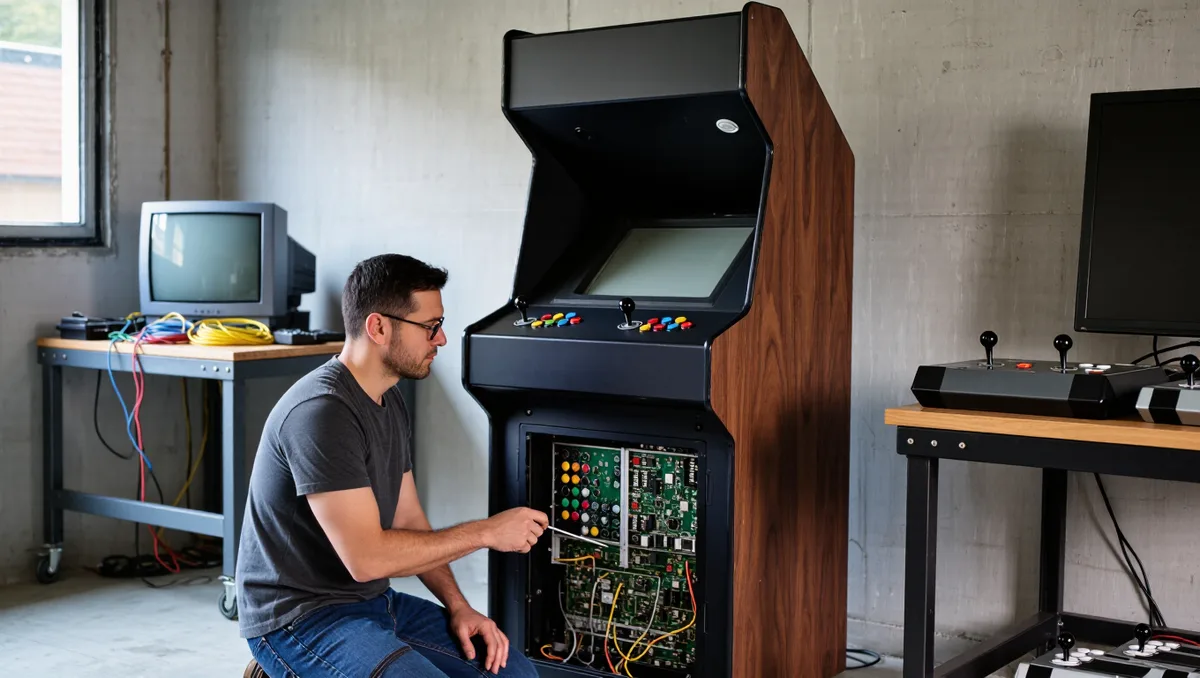
Arcade cabinet collecting is the preservation wing of retro gaming. Collectors hunt down original machines — the wood-and-steel cabinets that once stood in pizza parlours and arcades — and restore them to working order. The scene runs on two things: people willing to haul 300-pound cabinets out of basements, and a parts market built almost entirely on machines that could not be saved.
It is also the hardest form of the hobby. A cartridge sits in a drawer. A console needs a shelf. A cabinet needs floor space, a working CRT monitor, a power supply that has not cooked itself, and controls that survive thousands of quarters' worth of abuse. Collectors who take it on tend to describe it less as collecting and more as rescue.
Why cabinets are harder to save than consoles
Consoles were mass-produced for homes, so millions survive. Cabinets were produced for commercial venues, and operators treated them as income equipment, not heirlooms. Machines got moved, resold, converted to different games, and eventually scrapped for parts or landfill. Surviving examples of many titles are genuinely rare, and the ones that remain often carry decades of wear.
The monitor is the central problem. Arcade games of the classic era display on CRT tubes, which are heavy, high-voltage and no longer manufactured. When a tube fails, a collector's options are limited: find a donor tube from another machine, hunt a replacement from a shrinking supply, or accept a substitute display. That last option divides the community, because a cabinet with a modern screen is, to purists, no longer quite the machine.
Cabinet bodies have their own troubles. Water damage, cigarette smoke, particleboard that has swelled and crumbled, and side art scraped away by vacuum cleaners and moving vans. Restorers learn woodworking, vinyl application and paint matching for the same reason they learn soldering — nobody else is coming to do it.
What restoration actually involves
A full restoration is a long list of small jobs. Collectors typically work through something like this sequence:
- Assess the machine: what is original, what was replaced, what is missing.
- Make the cabinet safe. Old power supplies and monitors hold charge, so wiring gets inspected before anything powers on.
- Service or replace the monitor, usually with help from someone experienced, because CRT internals are genuinely dangerous.
- Rebuild the controls: buttons, joysticks, microswitches and wiring.
- Reproduce or clean artwork — marquees, side art, control panel overlays.
- Document everything, so the next owner knows what is original and what is not.
That last step matters more than outsiders expect. Within the scene, originality is tracked carefully. A machine with its original monitor bezel, artwork and control panel is worth more, in every sense, than one patched together from reproductions. Collectors keep records the way museums do, because the machine's history is part of what is being preserved.
The parts market runs on cannibalisation
Here is the uncomfortable engine of the hobby: many cabinets are saved only by parts taken from cabinets that were not. A dead machine with a cracked cabinet but a working monitor becomes a donor. Its tube, its wiring harness, its coin door live on inside another machine. Collectors trade, sell and hoard parts at swap meets, in online forums and through dedicated parts sellers.
Reproduction parts fill some gaps. New buttons, joysticks and microswitches are made again, and quality varies from faithful to frustrating. Marquees and artwork reproductions exist for popular titles. But structural pieces — specific cabinet shapes, unusual control panels, rare monitor models — often have no reproduction at all. When those parts fail, the donor pool is the only supply, and it shrinks every year.
What this means for anyone entering the hobby: the scarce resource is not machines, it's parts. A collector who buys a "broken" cabinet cheaply is often really buying its components. That is not cynical; it's how the ecosystem keeps working machines running at all.
Original hardware versus emulation inside a cabinet
Not every cabinet on the market holds original boards. A large second tier of the hobby involves putting emulation hardware inside real or replica cabinets. It is cheaper, more reliable and far more flexible — one machine can play hundreds of games. For most people who want the arcade look in a games room, it is the sensible route. For related coverage, see Retro Game Prices in 2026: What the Market Data Actually Shows.
Purists draw a line at the board. An original game PCB, the printed circuit board that actually runs the game, is the artefact. Its sound, its timing, its quirks on a period CRT are what collectors chase. Emulation gets remarkably close, and for many titles it is the only practical way to play at all — a problem covered in depth in our piece on the preservation gap, where the scale of unavailable classic games is laid out. But "close" is the operative word, and the cabinet scene largely exists because some people do not want close. This connects to our earlier piece, 87% of Classic Games Are Unavailable: Inside the Preservation Gap.
Is it worth the space and money?
Honest answer: usually not, if you are asking purely as a buyer looking for value. Cabinets demand floor space, careful moving, ongoing maintenance and a tolerance for machines that stop working on a Friday night. The sensible entry points are smaller — countertop machines, cocktail cabinets, or a single well-chosen title you genuinely love — rather than a wall of full-size cabinets.
If you are drawn to it anyway, the hobby rewards a specific temperament. You will be fixing things, not displaying them. You will need to learn from other collectors, because almost none of this knowledge is written down in one place. And you will occasionally carry something absurdly heavy up a flight of stairs, wondering why. The people who stay in the scene have an answer: these machines are the last physical form of an art form that mostly exists as code and memory now. Someone has to keep the boxes running.
Where the scene goes from here
The trajectory is clear. Supply of original machines and parts only shrinks. Reproduction hardware improves. The community increasingly splits into two camps — preservationists keeping original machines alive, and enthusiasts building beautiful cabinets around modern innards — with more overlap and less friction than the online arguments suggest. Both camps, in the end, want the same thing: a working machine in a room, with a coin door and a marquee, doing what it was built to do.
Our analysis is that cabinet collecting functions as de facto preservation infrastructure. Museums and archives preserve code and documentation. Collectors preserve the object itself — the thing you stand in front of, feed a coin into, and play. Both jobs matter, and only one of them currently has a supply chain.