The retro handheld market has exploded into a gadget category of its own: devices from Anbernic, Miyoo, Powkiddy and Retroid run everything from 8-bit consoles to early-2000s portables on hardware costing $50 to $300, per the manufacturers' product pages. The devices themselves occupy clean legal ground — emulators are legal software, and so are the machines that run them. The legal question attaches to the game files, and it is narrower than either the panic or the piracy marketing suggests: most developed countries' laws permit making a personal backup copy of a game you own, and prohibit distributing or downloading copies of games you do not. A legal handheld setup, then, starts with your own shelf.
Is emulation itself legal?
Yes, and the case law is old and settled. Emulators have survived legal challenge in the United States since Sony's lawsuit against Connectix over the original PlayStation emulator in 2000, which ended with Sony acquiring the company — courts found that clean-room emulation, reverse-engineered without stolen code, is lawful. Nintendo's ongoing legal actions target distributors of ROM files and tools marketed for piracy, not emulator technology in principle, per its public statements on the subject. The distinction matters for buyers: owning an Anbernic or a Miyoo is unambiguously lawful. What you load onto it is where every jurisdiction's rules begin.
What does the law say about backups of games you own?
This is the personal-use gray-to-legal zone, and it varies by country. In the United States, the Library of Congress's copyright office has granted exemptions in its triennial DMCA rulemakings allowing personal backups of video games for preservation and, in some rulemakings, for personal offline play where the publisher's servers have shut down, per the official rulemaking texts. Making a backup for personal use sits in a legally recognized zone; distributing it, or downloading someone else's copy, does not — courts and enforcement actions have consistently treated downloading as equivalent to distribution. In practical terms: dumping your own cartridges and discs is the defensible path; hitting a ROM site is not, regardless of what you own.
How do you actually dump your own games?
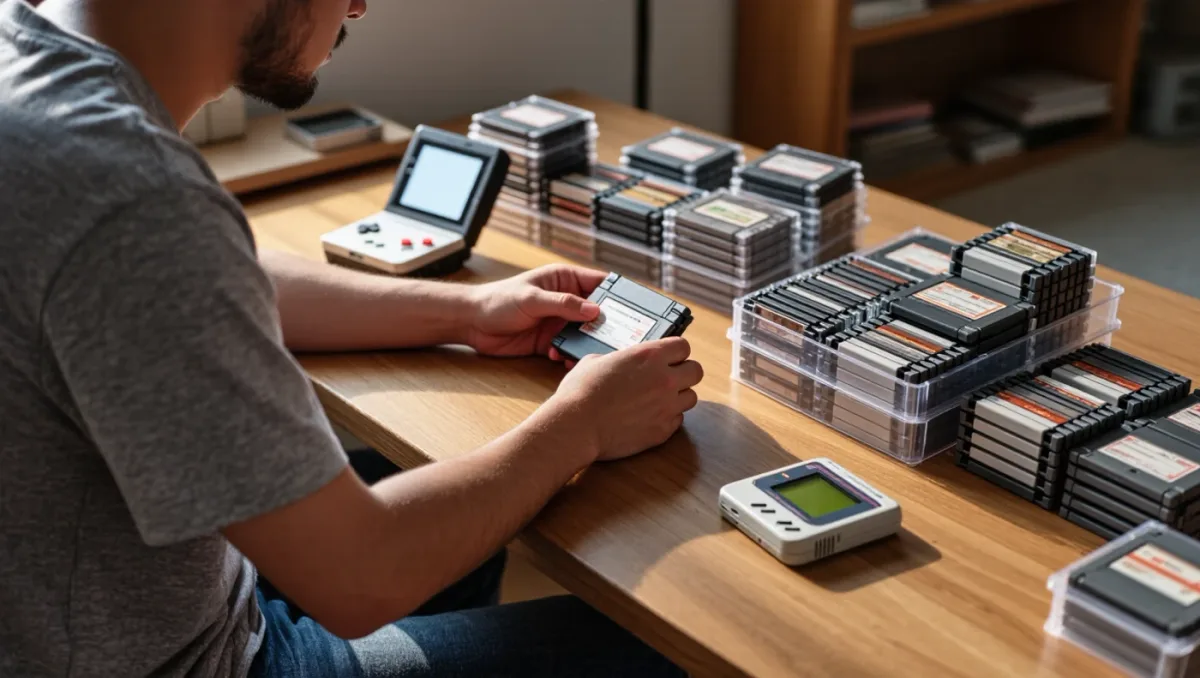
Tools exist for every era of media. Cartridges from the 8-bit through GBA eras dump through USB flash carts and dumper hardware — the Retrode-style adapters read Genesis and SNES carts directly, while GBxCart-style devices handle Game Boy, Color and Advance libraries, per the manufacturers' documentation. Disc-based systems differ: a Wii or GameCube library can be read through homebrew running on your own console, and Sony's own PS3 firmware once permitted game data dumps for its own services. The principle is uniform — the hardware reads media you physically own, and the resulting file lives on your own device. Time cost is the real price: a 200-game cartridge library takes evenings, not minutes, which is the honest tax of doing it right.
Which handheld suits which retro library?
The market segments cleanly by target era, per each manufacturer's specifications. Entry devices around $50-70 — the Miyoo Mini Plus and Anbernic's RG35XX line — handle the 8- and 16-bit generations and Game Boy families comfortably. Mid-tier devices near $80-150, like the Miyoo Flip or Anbernic RG406H-class hardware, reach the GBA, DS and early 3D consoles. The top segment — Retroid's Pocket line and Anbernic's RK3588-based units at $150-300 — runs GameCube, Wii and PlayStation 2 emulation, with the caveat that those systems demand configuration and legal dumping of your own discs. Screen quality, not raw power, separates the tiers most in practice.
What about digital storefronts as an alternative?
The legal shortcut exists and grows. Nintendo Switch Online's subscription catalogs deliver NES through N64 libraries lawfully, per Nintendo's service terms; Sony and Microsoft sell emulated classics through their stores; and Steam hosts an expanding shelf of re-releases from Digital Eclipse and Nightdive, whose remaster work, per their published design philosophies, often includes the original code running in enhanced wrappers. For a buyer whose goal is playing classic games rather than building an archive, $20-60 of legitimate storefront purchases covers a surprising fraction of any top-100 list — and handles saves, filters and controller support without configuration.
What should a careful buyer check before purchase?
Three things separate satisfying devices from drawer filler. Buttons: cheap D-pads and mushy face buttons define the entry tier's compromises, and community teardown reviews are more informative than spec sheets here — a device with an emulator list is only as good as its inputs. Screen: match the panel to your target era — a 640x480-class screen flatters 4:3 retro content, while wide hi-res screens overscan 16-bit pixels into letterboxed bands. And firmware community: devices with active custom firmware communities gain features for years, while abandoned platforms freeze at launch quality; a quick check of which devices have monthly community releases tells you which purchases age well. None of this touches the legal question, but all of it decides whether the legal library you are about to spend evenings building lives on a device worth opening.
Verdict
Buy the handheld for the hardware experience, then budget the time to load it from your own shelf. A $70 device plus your own dumped library is lawful in principle across most jurisdictions and fully lawful in practice if you never download or share files. For the impatient, the storefront catalogs and re-releases are the legitimate fast lane. What does not exist is a legal shortcut to someone else's ROM server — every legal path to retro gaming runs through either your own media or an official license.